Here's a number that might ruin your day: your 1 kHz control loop probably can't do better than 100 Hz bandwidth. And it gets worse.
Let me show you why—with a scenic tour through the Mountains of Gain! ⛰️
The One Delay You Can't Escape
Every digital control loop has at least one sample time of delay. It's physics, not a bug. This delay puts a hard ceiling on your bandwidth.
The surprising part? We can calculate this ceiling with high-school math.
The Topography of Stability
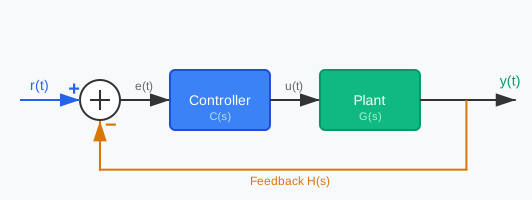
To analyze stability, we plot the open-loop gain. The rule is simple but unforgiving:
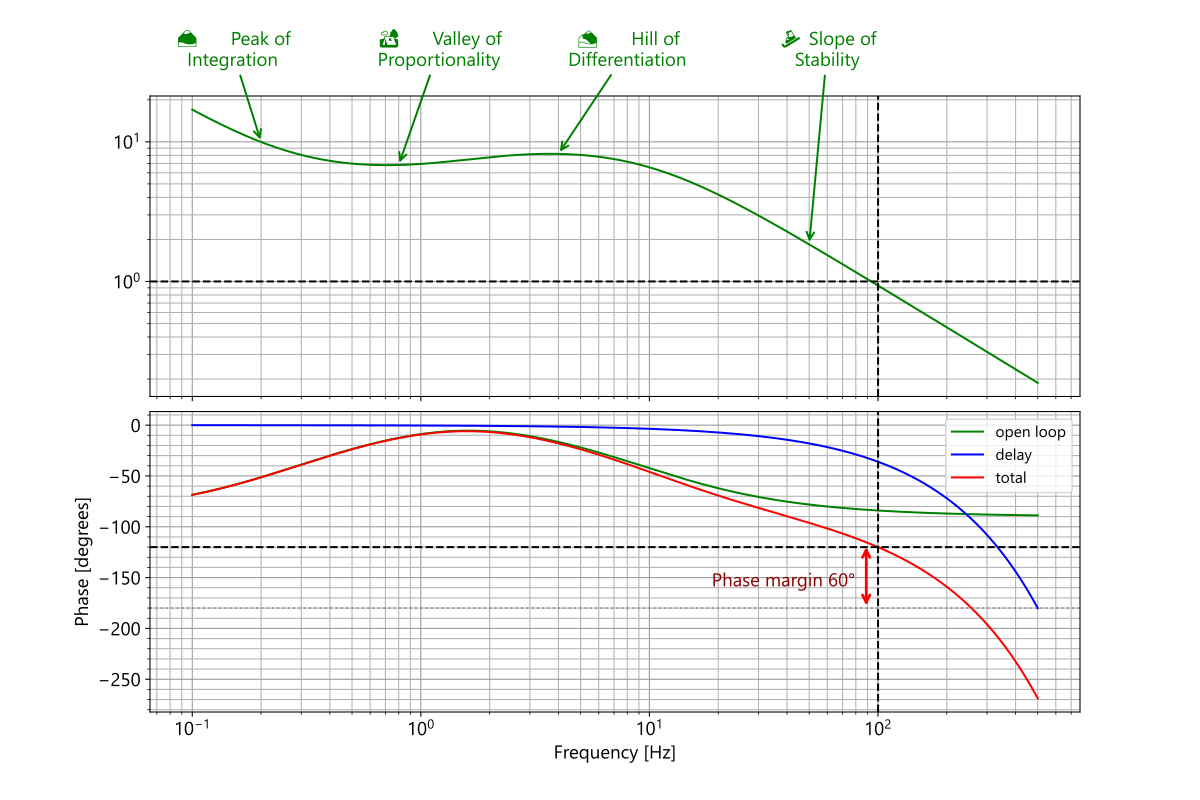
⚠️ When phase shift hits 180°, gain MUST be below 1 Otherwise? Your controller becomes an oscillator.
At crossover (gain = 1), we want breathing room—a "phase margin" of 45° to 60°.
Picture the gain plot as a mountain range:
- 🏔️ Peak of Integration — steep slopes, hunting for zero steady-state error
- 🏕️ Valley of Proportionality — the flat middle ground
- ⛰️ Hill of Differentiation — that little bump for speed
-
🎿 Slope of Stability — the mandatory descent to gain = 1
-
The Math (It's Simple)
Delay adds phase shift that increases linearly with frequency:
$$\varphi_{delay} = 360° \times \frac{f}{f_s}$$
At sample frequency $f_s$, you've accumulated 360° of phase shift.
Assume a first-order rolloff (the gentlest descent down the Slope of Stability). Often the plant provides this naturally—think motor inertia or thermal time constants. This rolloff contributes ~90° of phase shift.
Total phase at the critical point:
$$\varphi_{total} = \varphi_{plant} + \varphi_{delay} = 180° - \theta$$
Where θ is our phase margin. Solving:
$$90° + 360° \times \frac{f}{f_s} = 180° - \theta$$
$$f = f_s \times \frac{90° - \theta}{360°}$$
For θ = 60° → f = f_s / 10
The Reality Check 💥
Your 1 kHz control loop? Maximum bandwidth: 100 Hz.
But wait—there's more bad news!
Real systems have extra delays:
| Source | Delay |
|---|---|
| 📡 Communication bus | ~10 ms |
| 📉 Anti-aliasing filter | ~5 ms |
| ⏱️ Sample time at 1 kHz | 1 ms |
Total delay: 10 + 5 + 1 = 16 ms
🧠 Pop Quiz: What's the maximum bandwidth now?
...
Maximum bandwidth = 1 / (16 ms × 10) = 6.25 Hz
That's not a typo. Six hertz. From a kilohertz loop. 😱
The Takeaway
Before designing your next control loop, add up ALL delays:
- ✓ Sample time
- ✓ Communication latency
- ✓ Filter delays
- ✓ Computation time
Then divide by 10. That's your real bandwidth ceiling.
Surprised? How do YOU handle delay in your control systems?
#ControlSystems #Embedded #Engineering #DSP #RealTimeControl